The Logic Gap: Why Machines Reason Faster Than We Reflect
How programming principles reveal the blind spots in human thinking
One of our most remarkable abilities as human beings is, without a doubt, the capacity to think. Yet you don’t need to be an engineer to notice that machines are starting to reason better than we do — while many of us still can’t decide what to have for dinner.
What I want to explore in this post isn’t how fast computers think, but how they reason differently from us — and why understanding that difference is a powerful way to grasp how they “think” at all.

Photo by Yuheng Ouyang on Unsplash
The Illusion of Thinking Clearly
Let’s start with a simple truth: machines don’t think. They follow algorithms — recipes for solving problems — built from countless calculations and conditional steps. What we call machine thinking is really just an incredibly fast execution of instructions that gives us the illusion of thought.
We, on the other hand, like to believe we’re logical creatures. We weigh pros and cons, compare options, and proudly call that rationality. Yet that’s not how our minds actually work. We don’t run neat loops or predictable functions; we branch, recurse, and crash mid-thought — and most of the time, that’s perfectly fine.
The human brain isn’t a calculator; it’s a storyteller that can’t stand silence. When there’s a gap in logic, we fill it with narrative until it feels coherent. Machines, in contrast, follow whatever logic they’re given, step by step, without needing the story.
And that’s where the real contrast lies. Their reasoning is optimized; ours is interpreted. Machines execute; we explain. Learning from how they structure problems doesn’t make us mechanical — it makes us better problem-solvers.
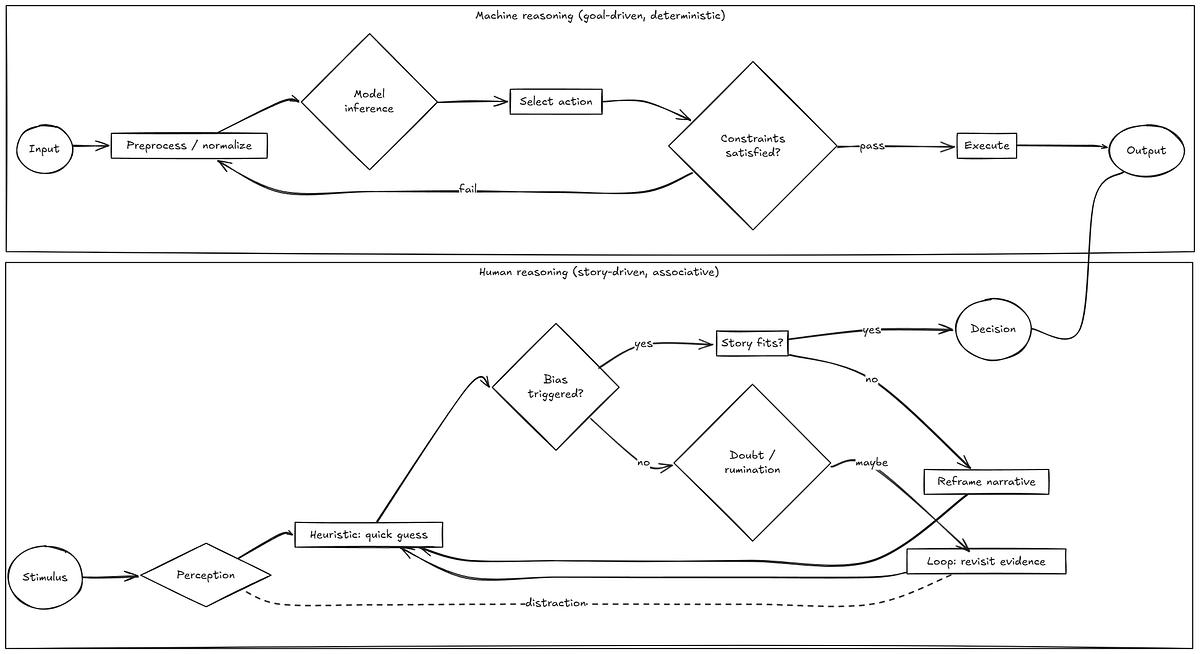
Humans vs Robots
Decomposition: How Programmers Think
Ask any good developer what they really do for a living, and if they’ve learned it the right way, they’ll probably say something like this: we solve problems by breaking them into smaller ones. That’s what we call decomposition.
It might sound like a bold statement, but this is the real heart of programming — not typing code, but dismantling complex problems into small, deterministic pieces that you can actually reason about. Each fragment becomes a tiny, solvable unit, and by combining those pieces, you get a system that works.
Unfortunately, that skill is slowly being left behind. After all, we live in the age of “I’ll just ask the chat to figure it out.” And sure — you can. But if that’s all you do, you’re not a problem solver anymore; you’re just a prompt sender.
Don’t get me wrong. I’m not anti-AI. I use “the Chat” too — probably the same LLM you’re using. It’s brilliant for repetitive tasks, great for generating ideas, and fine for learning something new. What it’s not doing, though, is making you better at the things you haven’t yet mastered.
Every time you debug something, you’re building a mental model of cause and effect. Every if and else reflects how you believe the world behaves. Repeating that process again and again reshapes your brain to think faster — and, in a sense, a bit more like a machine.

Decomposing
The difference is this: machines don’t decompose; they map. They recognize patterns across millions of examples and approximate structure. Humans, on the other hand, build rules — we reason our way there.
We both seek order — just from opposite directions.
Thinking Like a Machine (Without Becoming One)
In this context, thinking like a machine isn’t about becoming cold or mechanical. It’s about recognizing patterns, breaking problems into smaller, manageable pieces, and tackling them one step at a time.
There’s another lesson we can borrow from machines — as ironic as it sounds, given that we built them — and that’s the discipline of iteration. They don’t get tired of trying. They test, fail, adjust, and try again. That cycle isn’t algorithmic; it’s profoundly human.
Because the real danger isn’t machines learning to think like us. It’s us forgetting how to think at all — losing the ability to deconstruct, to reason, to reflect. The threat isn’t artificial intelligence; it’s our refusal to learn from how it learns.
Final Note
This piece was more about how we think than what we build. In the next posts, I’ll take this idea further — showing practical examples of decomposition in real problems, and even breaking down my own thought process while I’m decomposing. Meta enough? Probably. Useful? Definitely.
Machines iterate. We reflect. Let’s keep doing both.
If you’ve been keeping up with the content and have any questions don’t hesitate to reach out to me. Feel free to send an email to joao.scarpa@gmail.com, and I’ll be happy talk with you.